
The New Labor Equation: Artificial Intelligence & the Future of the Labor Market
Executive Summary
- Artificial intelligence (AI) is being adopted rapidly across the U.S. economy, yet the broad worker displacement widely expected to follow has not yet appeared and may not be a foregone conclusion.
- AI can affect the labor market through four channels: automating some work and reducing the need for workers, augmenting other work by making workers more productive, leaving some jobs relatively untouched, and creating new occupations and sources of labor demand over time.
- Early labor market evidence shows a clear divide, with stronger employment outcomes where AI enhances worker productivity and weaker outcomes where it is more likely to substitute for human labor.
- Recent college graduates have faced a more difficult labor market post-pandemic, but overlapping developments such as the proliferation of remote work make it difficult to attribute the softening to AI alone.
- AI is arriving as an aging population, lower birth rates, and slower immigration constrain U.S. labor supply growth, making the availability of workers an increasingly important part of the employment outlook.
- In the near term, softer labor demand and slower labor supply growth may help sustain today’s low-hire, low-fire environment, while longer-term productivity gains and new work could shift the balance toward greater demand for an increasingly constrained supply of workers.
The Next Great Labor Market Transformation
“Innovation is the ability to see change as an opportunity, not a threat.” — Steve Jobs
Most major technological advances arrive with the same question: what happens to workers as technology becomes capable of doing more? The question is not new, and neither are the answers it has produced. The transformation of agriculture in the U.S. over the past century offers one of the clearest examples of technology displacing human labor, as machines increasingly assumed tasks that once required large numbers of workers.
Roughly one in three American workers was employed in agriculture in 1910 compared with fewer than two out of every 100 today. Mechanization and other technological advances steadily reduced the need for labor while allowing a much smaller workforce to produce considerably more, with total farm output nearly tripling since the late 1940s despite declining headcount. Yet the economy did not run out of work: industrialization expanded manufacturing and drew workers away from agriculture and into a growing factory economy.
But not every technological wave has worked out this way. Where mechanized farm equipment replaced workers outright, the computer and the internet largely did the opposite. The latter automated particular tasks and a great deal of manual clerical work vanished, but the productivity they unlocked created far more work than they destroyed, setting off an explosion of new technical and professional occupations. Where one wave largely substituted for human labor, the other, on balance, amplified what workers could accomplish.
The contrast illustrates an important distinction in how technological change can affect employment, that is, whether it replaces the work people perform or increases their capacity to perform it. Each of these transitions displaced particular tasks and was met with fear that workers would be left behind. Yet each also raised productivity, lowered costs, created new businesses, and generated entirely new forms of work that would have been difficult to anticipate at the time.
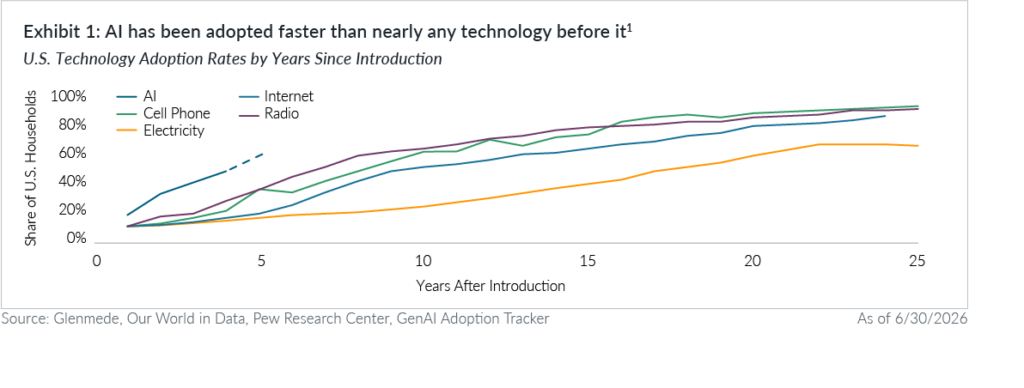
AI represents the next chapter of that story, and it is being written unusually fast. Where earlier general-purpose technologies took decades to diffuse through American households and businesses, AI has spread through the economy in just a few years, and on a trajectory far steeper than radio, cell phones, or the internet (Exhibit 1).
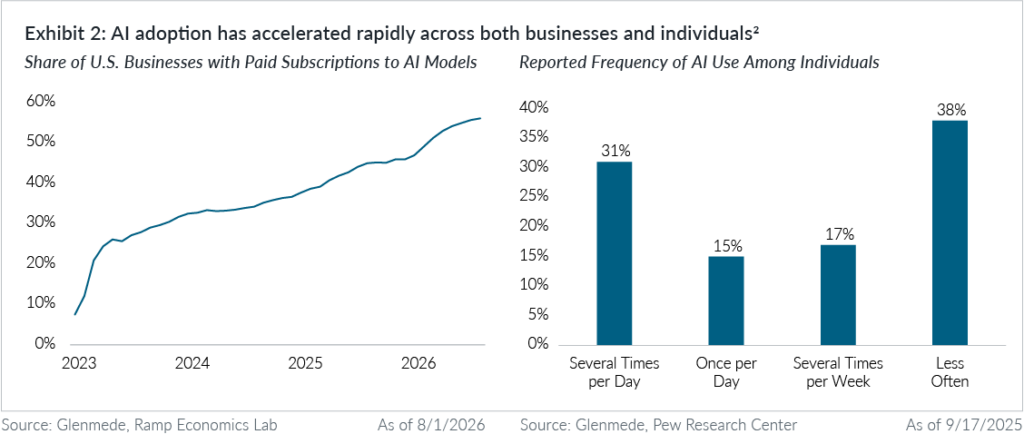
Businesses and individuals alike have been quick to put those capabilities to use. More than half of U.S. businesses now pay for AI-related tools, a significant jump in the span of only three years (Exhibit 2). Individual use has followed a similar path, with nearly half of respondents in a Pew Research Center survey reporting they use AI at least daily, including nearly one-third who turn to these tools several times per day. With AI increasingly capable of writing, analyzing, and communicating, its rapid adoption has naturally raised questions about what it could mean for hiring, job displacement, and the broader demand for workers.
The Demand Side of the Equation
“In theory there is no difference between theory and practice, while in practice there is.” — Benjamin Brewster
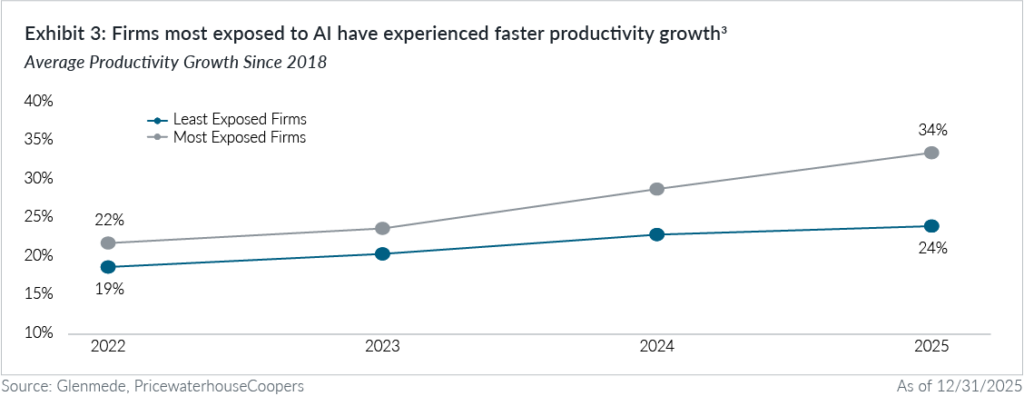
The intuitive concern about AI is straightforward: if it can perform more of the work currently done by people, companies should need fewer workers to produce the same amount of output. This logic has led many to expect rapid AI adoption to translate quickly into a negative feedback loop of job displacement and higher unemployment, but the data tell a more nuanced story so far. Among firms operating in industries expected to be most affected by AI, productivity has increased more rapidly than among firms with relatively low exposure to the technology (Exhibit 3). According to a PricewaterhouseCoopers study, since 2018 the most exposed firms have generated substantially stronger growth in revenue per employee, with the gap widening over time. While productivity can improve for many reasons, the result is consistent with the view that AI is helping workers produce more output with the same amount of labor.
The study also examined employment trends and found little evidence that firms with greater AI exposure have universally reduced headcount. In fact, employment at the most exposed firms was 52% higher in 2025 than in 2018 compared with 36% growth among the least exposed firms. This finding should be interpreted cautiously, however, as it may be influenced by survivorship bias. Firms that struggled to adapt to technological change or withstand the disruptions associated with the pandemic may have been acquired or exited the market altogether since 2018, leaving a sample that overrepresents organizations that have been most successful in adopting and benefiting from AI.
Economists have long argued that productivity-enhancing technologies do not necessarily reduce demand for labor. By allowing firms to produce goods and services more efficiently, these technologies can lower costs and expand demand. In some cases, rising demand more than offsets productivity gains, leading firms to increase output and hire additional workers even as each employee becomes more productive.
This dynamic is often described through the lens of the Jevons Paradox. In the 19th century, economist William Stanley Jevons observed that as steam engines became far more efficient in their use of coal, its consumption did not fall as many expected but rose instead. Cheaper, more efficient engines made coal economical for a vast range of new uses, and total demand exploded. The parallel to AI runs through a scarcer resource still: intelligence itself. If applied intelligence becomes dramatically cheaper, history suggests the economy is likely to find far more uses for it, not fewer.
As demand expands, firms may increase output enough to require additional hiring, which could explain why employment has remained resilient despite rapid advances in AI. Yet rising demand is likely just one of the forces shaping the labor market response to AI.
Three Pathways and an Underappreciated Fourth
The most useful answer returns to the contrast between technology that replaced the farm worker and technology that made the office worker more productive. AI is unlikely to impact every job equally, nor should it affect every task within a job in the same way. Its impact on existing work can therefore be understood through three broad pathways, with the direction of the employment effect dependent on which pathway dominates.
Read moreRead less
AI Reshaping the Workforce
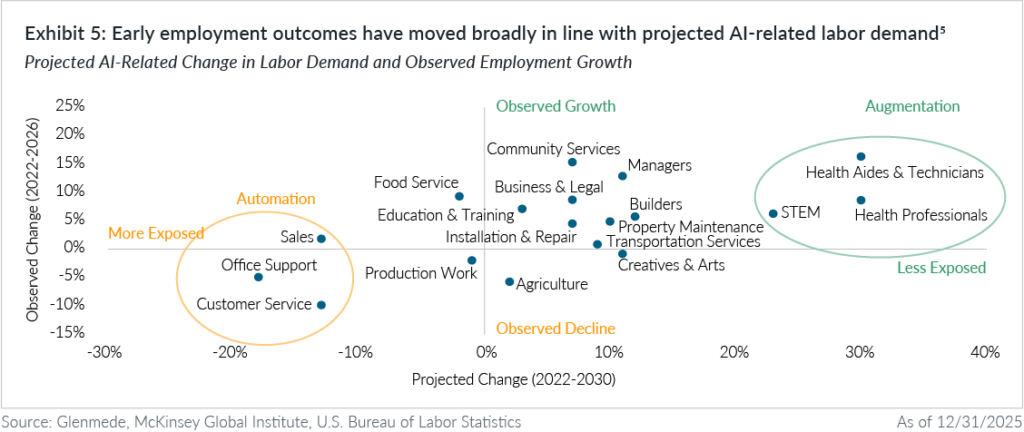
The same pattern appears at the level of individual occupations. A McKinsey Global Institute study projected a wide range of outcomes across occupations for AI-related labor demand from 2022 to 2030. Health care and STEM occupations (science, technology, engineering, and mathematics) were expected to see stronger demand as AI raised productivity or complemented existing skills, while office support and customer service occupations were anticipated to face weaker demand as the technology became capable of performing more of their tasks. With several years of that projection period now observable, early employment outcomes appear directionally consistent with those expectations (Exhibit 5). Those projected to see stronger labor demand have generally experienced stronger employment growth, while those facing greater potential for displacement have generally experienced weaker outcomes. The relationship is far from one-for-one, with several occupations performing well above or below what their projected AI impact alone would suggest. Many forces beyond AI may also be shaping employment, but the broad alignment between the projected and observed outcomes provides further evidence that the distinction between augmentation and automation matters in practice. Taken together, these three pathways capture the primary ways AI can reshape the workforce as we know it today by leaving many roles relatively unchanged, making some workers more productive, and reducing the need for others. Early evidence suggests all three are occurring simultaneously. That combination helps explain why AI’s aggregate effect on the labor market has so far looked less like a broad wave of displacement and more like a gradual reshuffling of employment beneath a relatively stable surface. While these three pathways provide a useful framework, they do not capture the full complexity of how AI may affect employment over time. It is difficult to draw a clear distinction between augmentation and automation. AI may make workers significantly more productive without replacing them outright, yet higher productivity alone does not guarantee stable employment. If productivity gains enable a firm to deliver its existing products and services with fewer employees and demand does not expand sufficiently to absorb that additional capacity, headcount may still decline even in occupations that are primarily being augmented rather than automated. Conversely, productivity gains can lower costs, expand demand, and support additional hiring. Which effect ultimately dominates is likely to vary across industries, occupations, and firms. As a result, AI’s long-run impact on employment remains uncertain and could involve both job creation and job displacement occurring simultaneously. [1]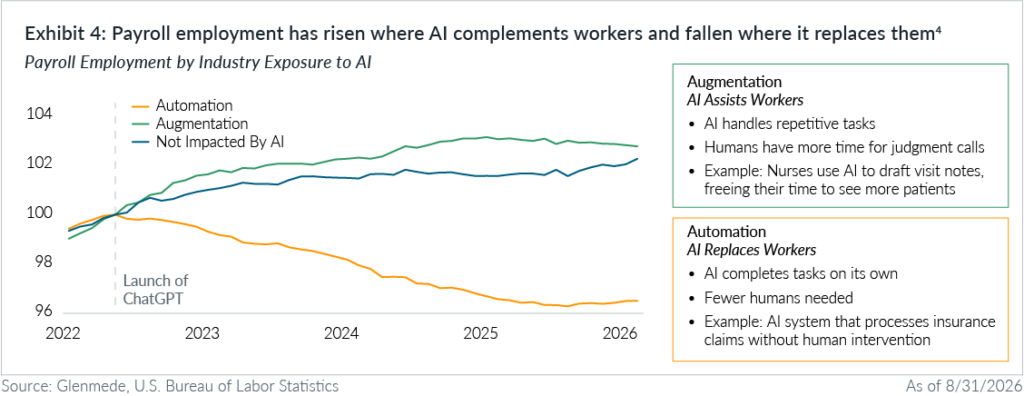
Read moreRead less
AI and Business Formation
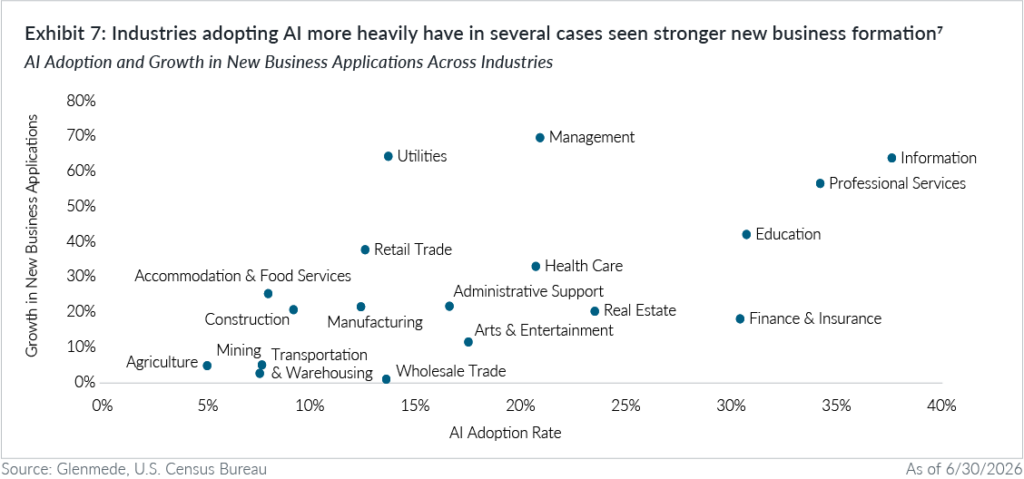
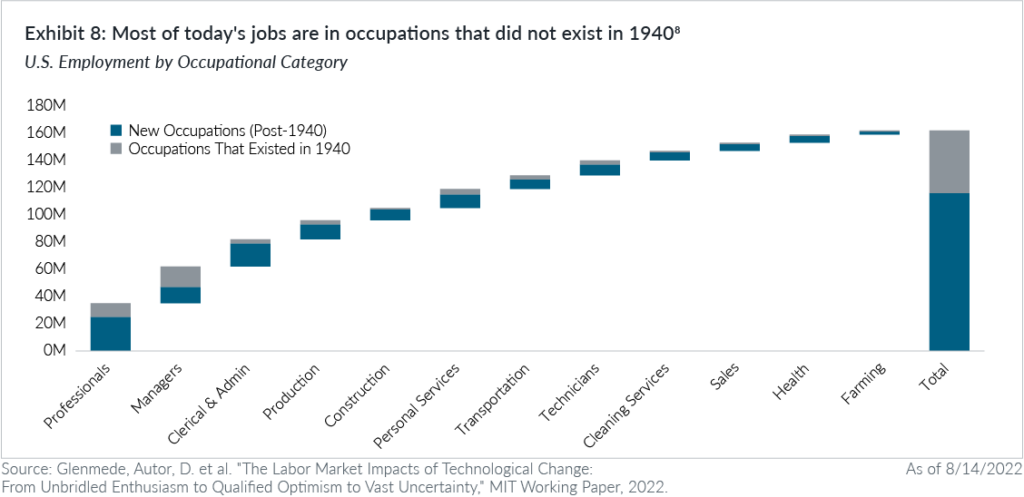
Across industries, there are also early signs of a relationship between AI adoption and business formation. Several industries with greater AI adoption have experienced stronger growth in new business applications, notably information, professional services, and management (Exhibit 7). The relationship is not universal, however, underscoring that AI is only one of many forces shaping entrepreneurship. It is far too early to know how many new businesses or jobs AI will create. But the early new business formation data provide an important counterweight to the displacement story, suggesting that AI may be creating new sources of labor demand at the very moment it reduces demand for certain existing tasks. History suggests this is not unusual and the creation channel can be significant. The composition of employment in the U.S. has changed dramatically alongside past waves of technological progress. Roughly 70% of the jobs Americans hold today are in occupations that did not exist in 1940 (Exhibit 8). Many of those roles would have been difficult to anticipate; imagine telling a toddler during the internet boom of the late 1990s that among their future job prospects would be roles such as social media influencer or professional gamer. AI-related occupations may prove similarly difficult to identify today. Ultimately, the technology’s impact on employment will depend not only on the existing jobs it changes or displaces, but also on the economic activity and entirely new forms of work it creates.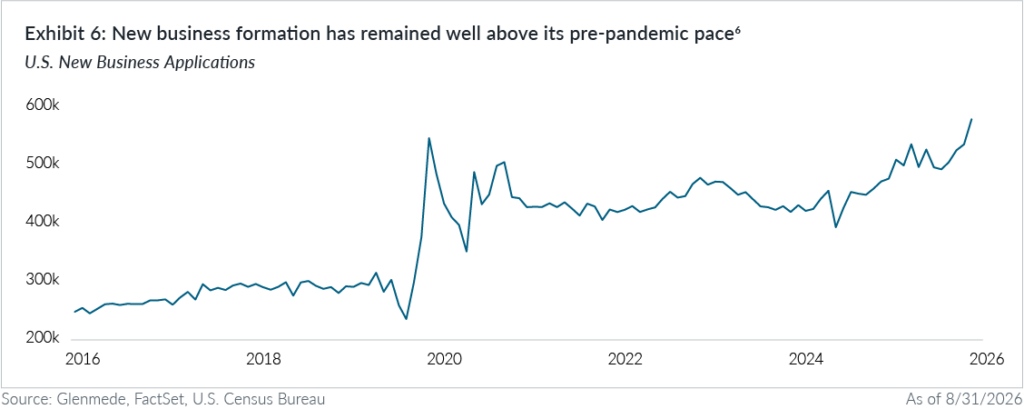
 [1]
[1]Read moreRead less
What About Recent College Graduates?
“It ain’t what you don’t know that gets you into trouble. It’s what you know for sure that just ain’t so.” — Josh Billings
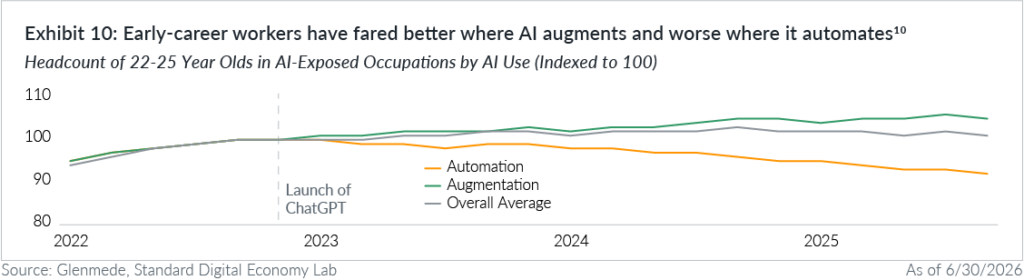
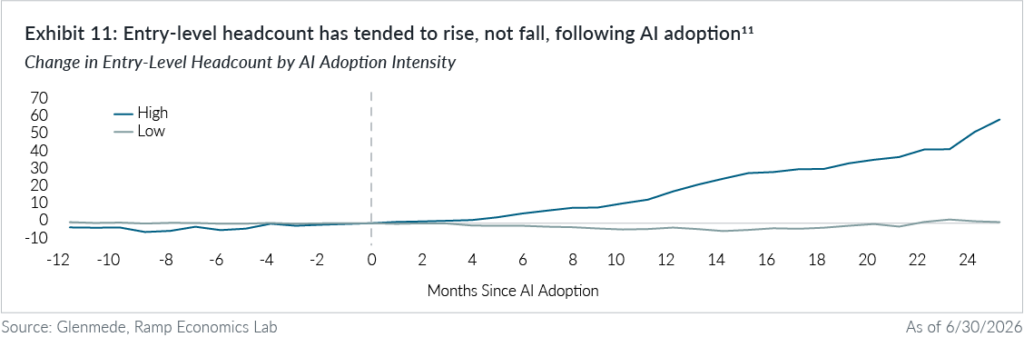
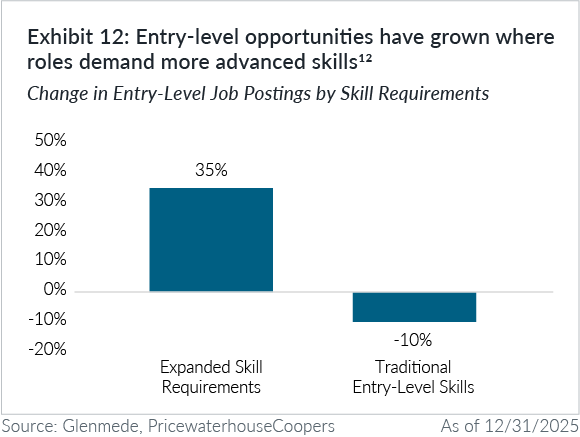
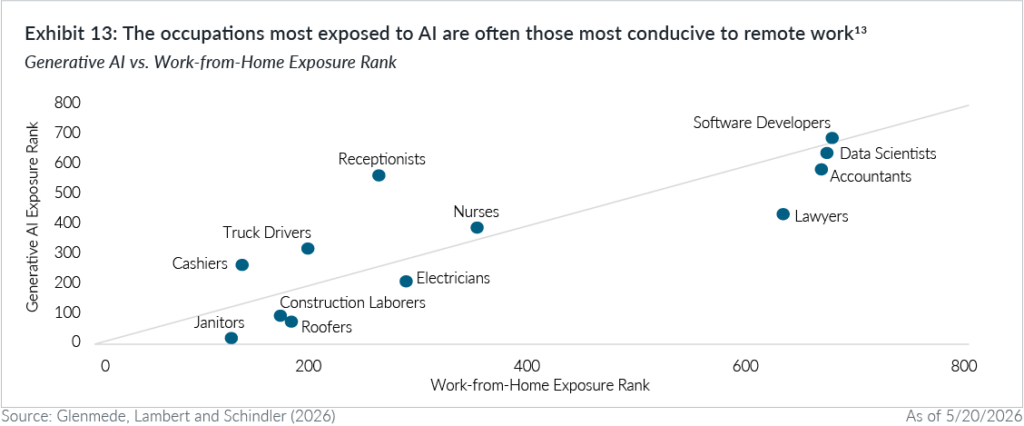
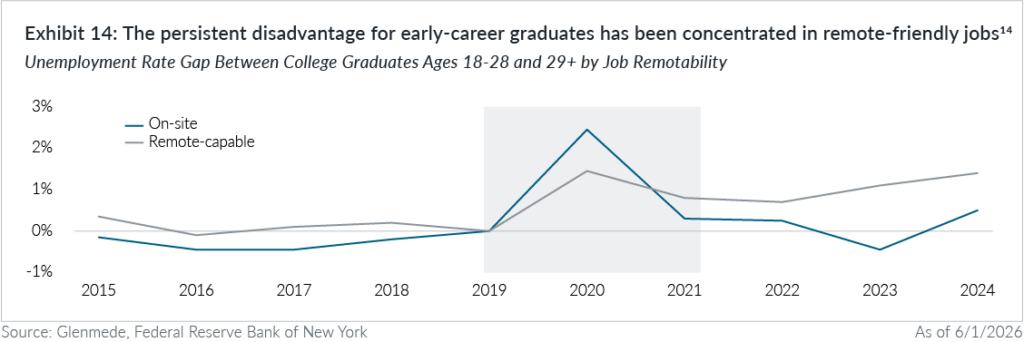
If AI were to displace workers, intuition suggests that recent college graduates would be among the most vulnerable. Many enter the workforce in roles involving precisely the kind of routine analytical work that increasingly capable AI models can perform. The recent college graduate labor market therefore offers a natural place to look for early signs of displacement, and there has been some weakness. Unemployment for those beginning their professional careers has risen moderately, while the labor market advantage they have historically enjoyed relative to the broader workforce has reversed (Exhibit 9). Together, these trends have fueled concerns that early-career workers may be among the first to feel the adverse effects of AI. The softening in the recent graduate labor market is clear, but whether AI is responsible is a more complicated question. A closer look suggests that the same automation-versus-augmentation distinction shaping the broader labor market also applies to early-career workers. Among workers ages 22 to 25, headcount has declined most in occupations where AI is used more heavily to automate work, while employment has been more resilient in occupations where AI is used primarily to augment workers (Exhibit 10). In other words, early-career workers do not appear uniformly vulnerable to AI. What matters more is how AI affects the work performed in the industries they seek to enter. Firm-level evidence reinforces this conclusion. If AI adoption were systematically displacing entry-level workers, firms adopting AI more intensively would be expected to reduce junior headcount most sharply. Instead, entry-level headcount has increased following adoption among these high-intensity AI adopters (Exhibit 11). This does not suggest that entry-level work is unchanged. Rather, AI adoption may be reshaping the skills and tasks firms demand from entry-level workers without broadly reducing their numbers. Evidence from job postings supports this distinction. Among occupations most exposed to AI, firms are increasingly seeking entry-level workers with skills that historically were more common in experienced roles. Postings for entry-level positions requiring more than 10 of these new, traditionally more senior skills increased 35% between 2019 and 2025, while postings for more traditional entry-level positions declined 10% (Exhibit 12). Together, the evidence suggests that AI may be changing what firms expect from workers at the beginning of their careers rather than simply eliminating those opportunities. If AI is not the whole story, what else might be happening here? There could be a structural change that predates the recent surge in AI adoption: the rise of remote and hybrid work. That shift is particularly relevant to early-career employees, who typically require more training, supervision, mentorship, and informal learning at the beginning of their careers, all of which can be harder to replicate outside a shared workplace. The challenge is that remote work and AI exposure are closely intertwined. Occupations such as software developers and data scientists rank near the high end of both AI exposure and the ability to work from home, while more hands-on occupations such as janitors, roofers, and construction laborers rank near the low end of both measures (Exhibit 13). This overlap makes it difficult to determine how much of the recent weakness reflects AI and how much reflects broader changes in how and where work is done. Recent patterns suggest remote work is an important part of the story. Before the pandemic, the unemployment gap between college-educated workers ages 18 to 28 and those 29 and older was minimal both in occupations that could be performed remotely and those that required in-person work (Exhibit 14). Post-pandemic, unemployment initially rose more for early-career workers in occupations that required in-person work, but the gap gradually narrowed and had largely returned to its pre-pandemic level by 2023. In occupations that could be performed remotely, however, the gap widened and remained elevated at roughly 1.0% to 1.5% through 2024. The lasting disadvantage for younger college-educated workers has been concentrated in occupations that can be performed remotely, while the gap in occupations requiring in-person work has largely disappeared. There are good reasons to think remote work may weigh more heavily on early-career employees than on their more established colleagues. Early career workers rely more heavily on in-person learning, including hands-on training and supervision, the informal knowledge gained from observing experienced colleagues, and the mentorship and professional networks built through daily interaction. Much of this is harder to replicate remotely, which can make training and supervising an inexperienced worker more difficult and costly. Employers may therefore favor more experienced workers who require less oversight, putting early career professionals at a disadvantage in jobs that can be performed remotely. Taken together, the recent graduate evidence points to a more nuanced picture than the headlines suggest. Early career workers have faced real challenges, but the weakness has been concentrated rather than broad, and AI exposure alone does not explain where it has emerged. Outcomes have been weaker where AI is more likely to automate work and more resilient where it augments workers, while firms adopting AI most intensively have not broadly reduced entry-level headcount. Instead, AI appears to be changing the nature of entry-level work, including the skills employers expect from workers earlier in their careers. At the same time, remote work overlaps heavily with AI exposure and has created its own challenges for early-career workers, making it difficult to separate the effects of the two. The evidence so far does not point to AI as a singular threat to recent graduates. Rather, early-career workers are entering a labor market being reshaped by several forces at once, changing both available opportunities and what employers expect. 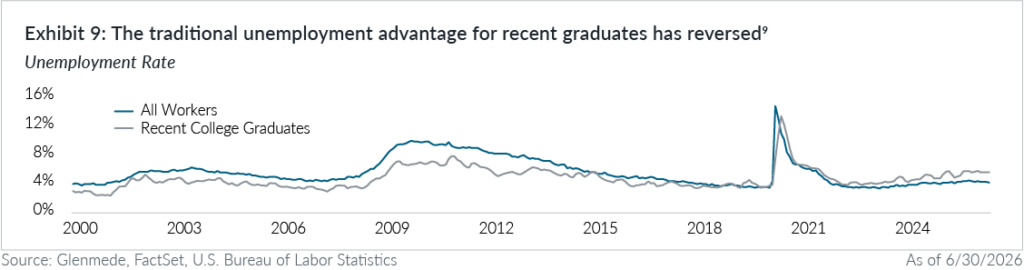
Read moreRead less
The Other Side of the Equation: Labor Supply
“There is nothing permanent except change.” — Heraclitus
Much of the debate over AI and employment focuses on labor demand, particularly whether the technology will reduce the number of workers that businesses need. But that question assumes there will be enough workers available to meet that demand in the first place. At the same time that AI is reshaping work, structural changes are slowing the growth of the U.S. workforce. An aging population is pushing more Americans into retirement, while falling birth rates mean fewer workers will enter the labor force to replace them. Immigration has helped offset these demographic pressures, but that important source of labor force growth has also slowed considerably from its recent pace. Together, these forces are likely to constrain the supply of workers and change the labor market backdrop against which AI adoption is unfolding.
Consequences of an Aging Population
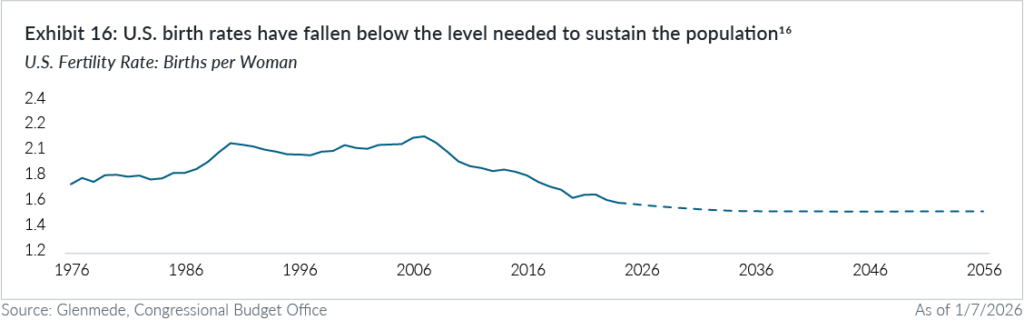
Compounding the demographic shift is the U.S. fertility rate, which has fallen to roughly 1.6 children per woman, well below the replacement rate of about 2.1 needed for one generation to replace itself over time (Exhibit 16). If aging means a large generation is moving out of the workforce, lower fertility means a smaller generation is coming in behind it. That makes the labor supply constraint harder to reverse. Even after the baby-boom retirement wave passes, fewer younger workers entering the workforce will continue to weigh on labor force growth.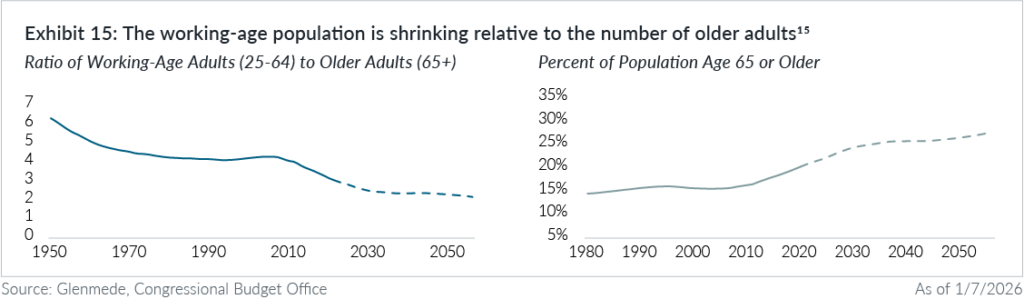
 [1]
[1]Read moreRead less
The Role of Immigration
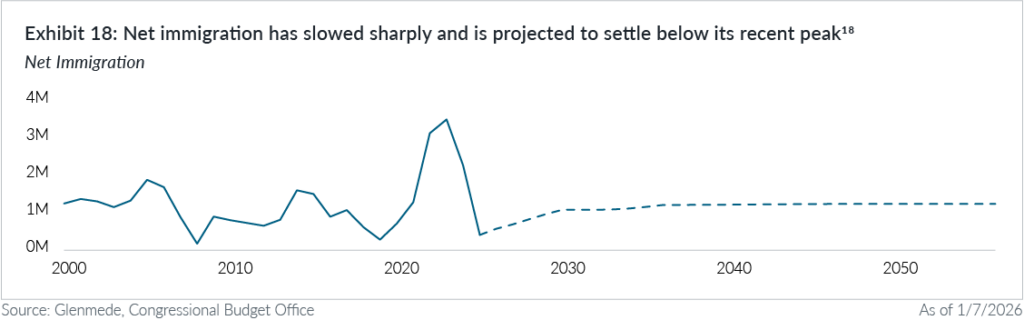
Unlike aging and birth rates, immigration can change relatively quickly in response to policy and economic conditions. The elevated inflows of recent years added meaningfully to the labor force, helping businesses fill open positions and contributing to the rebalancing of the labor market after the pandemic. More recently, net immigration has slowed from those levels, and projections from the Congressional Budget Office point to a lower and more stable pace over the coming years (Exhibit 18). If that slower pace is sustained, immigration would add fewer workers to the labor supply than it did during the recent period of elevated inflows. With the domestic workforce already facing pressure from an aging population and lower birth rates, that would leave less of an offset to those demographic constraints.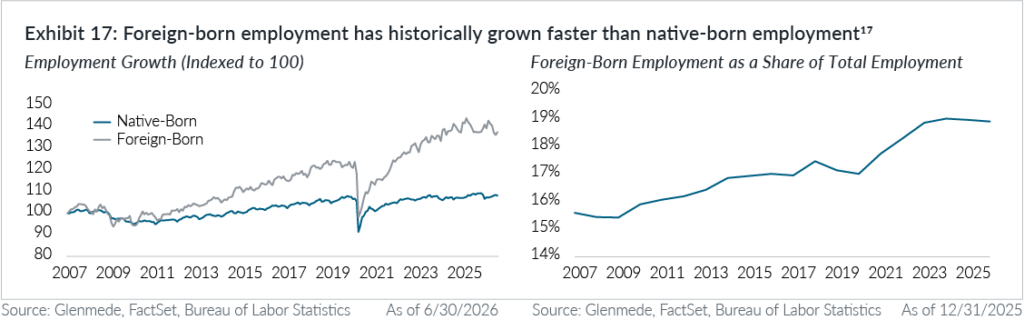
 [1]
[1]Read moreRead less
The New Labor Equation
Today’s labor market is defined by an unusual combination of low hiring and low firing. The labor market has cooled considerably from the tight conditions that followed the pandemic, when employers competed aggressively for workers and job-switching was widespread, but the slowdown has taken an atypical form. Hiring has slowed markedly and much of the churn of the post-pandemic period has faded. Workers are far less likely to leave their jobs voluntarily, while those searching for new roles are finding that the process is taking longer. At the same time, employers have been reluctant to cut existing headcount, holding on to workers even as they slow the pace of hiring. The result is a labor market that is quiet on both sides, with subdued hiring and restrained layoffs, an equilibrium that has kept unemployment low even as headline jobs figures have lost momentum.
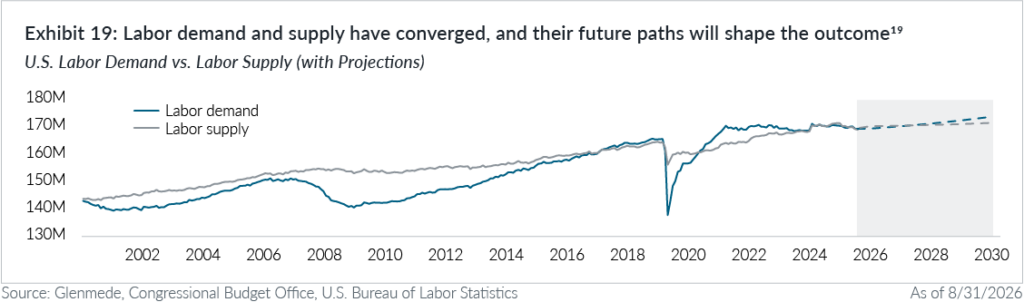
The near-term impact of AI cannot be judged apart from this backdrop. On the demand side, AI-driven automation may reduce the need for certain workers or restrain hiring at the margin. On the supply side, an aging workforce and slower immigration may constrain the number of workers available to businesses. These forces pull in opposite directions, which may help explain why the near-term picture looks less like widespread unemployment and more like a continuation of the low-hire, low-fire environment (Exhibit 19).
Which way that balance ultimately tips will depend on how a handful of distinct forces evolve. The health of the broader economy sets the backdrop. Strong productivity growth can support economic activity and labor demand, while a recession would weaken demand for workers regardless of AI’s impact. The economic cycle will therefore play an important role in determining how the balance between labor demand and supply evolves. Demographics work on the supply side, where an aging population, falling birth rates, and lower net immigration all point toward slower workforce growth. The pace of AI adoption determines how quickly these effects take hold, and adoption itself will depend on implementation costs, practical barriers, and the degree of policy support behind the technology. Labor market adaptation is the hardest piece to predict. Whether productivity gains ultimately translate into job displacement, stronger hiring, or some combination of the two will depend heavily on how businesses respond and whether demand expands enough to absorb the additional productive capacity AI creates.
Over the longer term, the balance could shift again. If AI raises productivity, lowers costs, and creates new sources of economic activity as expected, labor demand may eventually expand even as workforce growth remains constrained. The economy could then face the opposite of the problem now feared: too few workers rather than too few jobs. The question is not simply whether AI will reduce the need for workers, but whether the demand for workers that emerges alongside AI will grow faster or slower than the supply of workers available to meet it.
The Labor Market Ahead
The evidence suggests that AI is reshaping the labor market, but not in the simple direction that fears of widespread displacement would imply. Its effects are operating through several channels at once. Automation can reduce the need for certain tasks, while augmentation can make workers more productive and, in some cases, support labor demand. Many jobs remain relatively insulated from the technology, and AI may eventually create new occupations, businesses, and forms of work that are difficult to identify today. The balance between these forces, rather than AI exposure alone, will determine the ultimate effect on employment.
That distinction helps explain why broad displacement has yet to emerge despite rapid adoption. It also helps put the recent weakness among college graduates into perspective. Early-career workers have faced real challenges, but the softness has been concentrated rather than broad, with outcomes differing depending on whether AI is more likely to automate or augment the work being performed. Firm-level studies do not point to widespread entry-level job losses following AI adoption, while changes in remote work may also be contributing to the pressure facing younger workers. The broader lesson is that how AI is used matters more than whether a worker or occupation is simply exposed to it.
AI is also arriving at a time when labor supply is becoming more constrained. An aging population, lower birth rates, and slower immigration all point toward slower workforce growth. That changes the implications of even modest shifts in labor demand. Automation may restrain hiring at the same time that demographics limit the number of available workers, helping sustain a low-hire, low-fire labor market rather than producing a large rise in unemployment. Augmentation can help a slower-growing workforce produce more, while new forms of work could add to labor demand. Whether those productivity gains ultimately support additional hiring will depend in part on how businesses choose to deploy the additional capacity AI creates.
Where this balance ultimately settles remains uncertain. AI should not be viewed as a single force eliminating jobs but rather as a technology changing the mix of work the economy needs at the same time that demographic forces are changing the number of workers available to do it. The defining question may ultimately be less about whether AI leaves too few jobs for workers and more about whether the economy can generate enough workers for the jobs that remain and the new ones that AI helps create.
1 Shown are U.S. adoption rates for selected technologies by years since introduction. The AI series combines Pew Research Center survey data with a full-year estimate based on quarterly adoption data from the Real-Time Population Survey’s Generative AI Adoption Tracker. Historical technology series measure household adoption and may differ in population and methodology from the AI series. Actual results may differ materially from estimates or projections.
2 Shown on the left are estimates of the share of U.S. businesses with paid subscriptions to AI models, platforms, and tools based on spending data from more than 70,000 businesses. Shown on the right is the percentage of individuals by self-reported frequency of AI use based on a September 2025 Pew Research Center survey. Actual results may differ materially from estimates or surveys.
3 Shown is average productivity growth since 2018 for firms in the highest (Most Exposed) and lowest (Least Exposed) quartiles of AI exposure. AI exposure is based on PricewaterhouseCoopers’s industry-level classification of expected AI impact. Productivity is measured as revenue per employee.
4 Shown are payroll employment indexes for industries classified as primarily exposed to AI-driven automation, augmentation, or not impacted by AI based on a Glenmede analysis of U.S. Bureau of Labor Statistics payroll industry categories. Indexes are rebased to 100 at the launch of ChatGPT in November 2022. Actual impacts from AI may differ materially from expectations.
5 Shown are projected changes in labor demand by occupation attributable to AI from McKinsey Global Institute between 2022 and 2030 (x-axis) and observed employment growth by occupation between 2022 and 2025 based on Occupational Employment and Wage Statistics (OEWS) data from the U.S. Bureau of Labor Statistics (y-axis). STEM refers to occupations in science, technology, engineering, and mathematics. Actual results may differ materially from projections.
6 Shown are monthly new business applications in the U.S., measured in thousands.
7 Shown are industry-level AI adoption rates from the U.S. Census Bureau’s Business Trends and Outlook Survey (x-axis) and the percent change in new business applications filed by industry (y-axis).
8 Shown is employment by occupational category for occupations that existed in 1940 (gray) and occupations introduced after 1940 (blue). Occupations are classified by identifying new occupations that appeared in U.S. Census data from 1940 to 2018 and linking them to employment levels.
9 Shown are the U.S. unemployment rates for all workers ages 16 years and over in blue and recent college graduates ages 22 to 27 with a bachelor’s degree or higher in gray.
10 Shown are indexed headcount levels for workers ages 22 to 25 in occupations highly exposed to AI, separated by whether AI use primarily automates or augments work. Automation and augmentation classifications are based on Stanford Digital Economy Lab analysis using generative AI usage data from the Anthropic Economic Index. Headcount is indexed to 100 at the launch of ChatGPT in November 2022, and the overall average reflects employment across the occupations included in the analysis.
11 Shown are entry-level headcount changes following AI adoption across more than 21,000 U.S. firms from January 2021 through February 2026. Adoption requires at least $100 in monthly AI vendor spending for three consecutive months, with the top third of firms by AI spending per employee classified as high-intensity adopters.
12 Shown is the percent change in U.S. entry-level job postings from 2019 to 2025 among occupations in the highest quartile of AI exposure, separated by skill requirements. Entry-level positions are defined as those requiring zero to two years of experience. Expanded-skill positions require at least 10 skills that are new to entry-level roles and were traditionally associated with more experienced positions.
13 Shown are occupation rankings by work-from-home exposure (x-axis) and Generative AI exposure (y-axis). Generative AI exposure ranks are based on the share of tasks in a given occupation that could be done by a large language model. Work-from-home exposure ranks are based on job postings for that occupation that allow for remote work.
14 Shown are the unemployment rate differences between college graduates ages 18 to 28 and those age 29 and older in remote-capable and on-site occupations, relative to 2019 levels. The blue line represents remote-capable occupations, while the gray line represents on-site occupations. Gray shading denotes the early pandemic period.
15 Shown on the left is the ratio of working-age adults ages 25 to 64 to adults age 65 and older. Shown on the right is the share of the U.S. population age 65 and older. Solid lines represent historical data and dashed lines represent Congressional Budget Office (CBO) projections. Actual results may differ materially from estimates or projections.
16 Shown is the average number of births per woman in the U.S. The solid line represents historical data, while the dashed line represents Congressional Budget Office (CBO) projections. Actual results may differ materially from estimates or projections.
17 Shown on the left are employment levels for foreign-born and native-born workers, indexed to 100 at the start of the period to compare employment growth over time. Shown on the right is the share of total U.S. employment accounted for by foreign-born workers.
18 Shown is U.S. net immigration over time. The solid line represents historical data, while the dashed line represents projections from the Congressional Budget Office (CBO). Actual results may differ materially from estimates or projections.
19 Shown in blue are estimates of aggregate labor demand in the U.S. defined as the number of employed individuals plus job openings. Shown in gray are estimates of aggregate labor supply in the U.S., defined as the number of employed plus unemployed individuals. Solid lines represent actual figures, and dashed lines represent projections based on Glenmede’s analysis. Actual results may differ materially from projections.
This material is provided solely for informational or educational purposes and is not intended as personalized investment advice. When provided to a client, advice is based on the client’s unique circumstances and may differ substantially from any general recommendations, suggestions, or other considerations included in this material. Any opinions, recommendations, expectations, or projections included herein are subject to change, and any potential outcome discussed, including but not limited to performance, legislation, or tax consequence, ultimately may not occur. Information obtained from third-party sources is assumed to be reliable but may not be independently verified, and the accuracy thereof is not guaranteed. Any company, fund, or security referenced herein is provided solely for illustrative purposes and is not a recommendation to buy, hold, or sell it. Any reference to risk management or risk control does not imply that risk can be eliminated. All investments have risk. Readers should contact Glenmede or consult with a financial, investment, tax, legal, or other advisor if they have any questions about this material or want advice or more information.